


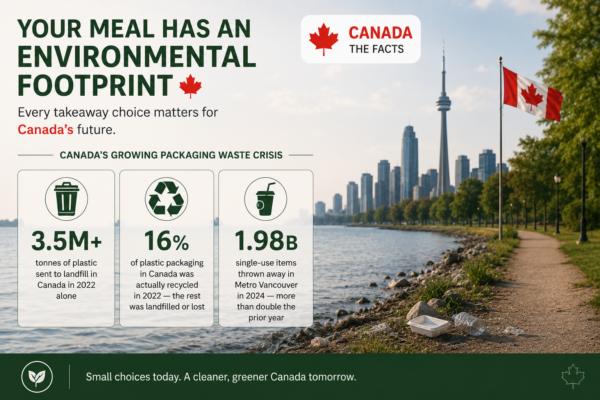
3.5M+ tonnes of plastic sent to landfill in Canada in 2022
16% of plastic packaging actually recycled in Canada in 2022
1.98B single-use items thrown away in Metro Vancouver in 2024 — double the prior year
Every takeaway meal carries a hidden price tag — not on the receipt, but on the environment. A typical food delivery order arrives in a plastic bag, sealed container, lid, paper bag, cutlery bundle, and condiment sachets. Multiply that across millions of Canadians ordering from Uber Eats, Skip The Dishes, and DoorDash daily, and the footprint becomes impossible to overlook.
Over one-third of all plastics in Canada are manufactured for single-use products or packaging. In 2024, more than 70% of key product shelves in major Canadian grocery chains — including soups, baby food, and pet food — were packaged entirely in plastic.
A crisis hiding in plain sight — city by city
In Metro Vancouver, residents discarded nearly 1.98 billion single-use items in 2024 — more than double the 888 million thrown away the year before, driven largely by the surge in food delivery. Disposable utensils alone more than tripled in a single year. In Toronto, Montreal, and Vancouver, residents average 680 kg of waste per person annually, well above Canada’s national average of 650 kg — itself one of the highest per capita figures in the world.
46.5% of all food produced in Canada is wasted — worth $58 billion a year. The average Canadian household throws away 79 kg of food annually. When that food is wasted, so is every layer of packaging it arrived in.
The takeaway boom is a packaging problem
Agriculture and Agri-Food Canada found that by 2024, delivery-first restaurants held the largest share of the Canadian food service market. Every order placed represents a cascade of disposable materials — and only 16% of all plastic packaging in Canada was successfully recycled in 2022. The food service sector’s recycling rate was even lower, at just 11%. Between 2019 and 2024, rigid plastic waste in Canada rose 17%, driven heavily by food packaging growth.
Canada is acting — but there is more to do
Federal Single-use Plastics Prohibition Regulations banned plastic cutlery, bags, straws, stir sticks, ring carriers, and problematic food service ware between 2022 and 2024. British Columbia went further, banning polystyrene foam food service ware in 2024. Toronto’s Single-Use and Takeaway Items Bylaw came into effect in March 2024. And in Toronto and Vancouver, Uber Eats launched reusable container pilots with local partners, as part of a commitment to plastic-free deliveries by 2030.
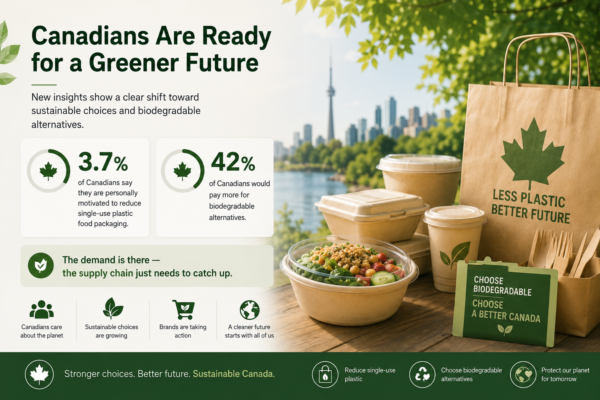
93.7% of Canadians say they are personally motivated to reduce single-use plastic food packaging. Nearly 42% would pay more for biodegradable alternatives. The demand is there — the supply chain just needs to catch up.
Sustainability begins with the packaging we choose
The global eco-friendly food packaging market was valued at over USD $206 billion in 2025 and is forecast to reach $608 billion by 2040. For Canadian food businesses navigating tightening regulations and eco-conscious customers, switching to compostable, recycled, or renewable packaging is no longer just ethical — it’s strategic. Every meal is a chance to leave a smaller mark. The choices made today will shape what Canada’s waste picture looks like in 2030.
Sources: Canada Plastics Pact 2024 Progress Report; Statistics Canada Plastic Life Cycle Data (2023, 2025); Metro Vancouver Solid Waste Services Report (2025); Environmental Defence Canada (2024); Second Harvest & VCMI Food Waste Report; Uber Canada Sustainable Packaging Pilot (2023); Government of Canada Single-use Plastics Prohibition Regulations; Nature.com Single-Use Plastics Consumer Survey — Canada (2021); Roots Analysis Eco-Friendly Food Packaging Market (2026).


